
I Went Quiet Here for a Year Here. AI Didn't!

A confession, a warning, and an invitation from someone who now runs his office with agentic workflows and prompts.
This blog has been silent for almost a year. I owe you an explanation, and it is a strange one:
I stopped writing here because I was too busy watching things change. When I last posted here, I was a Law Dean. Today, I am a Pro Vice Chancellor looking after student success across an entire university. And somewhere in that transition, something happened that I could not stop thinking about long enough to blog about it.
I started delegating my office to AI for pattern-based and process-driven work. And it worked.
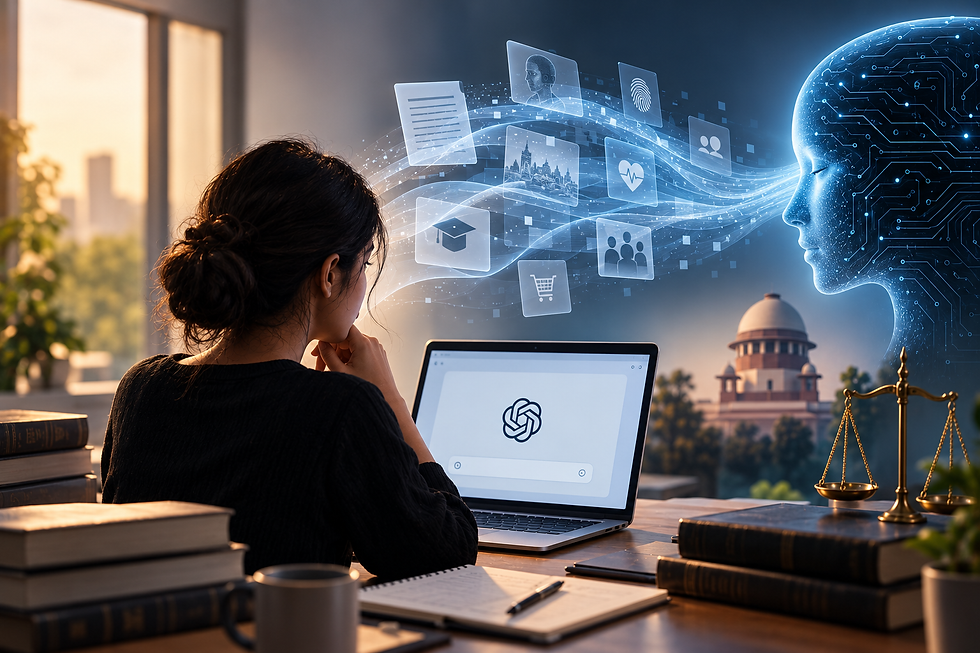
Not "AI as a buzzword in a conference panel" worked. It actually worked. Drafting, routing, initial research, first-cuts of drafts, managing calendars, creation of blog prints, etc. I mean all the kind of work that used to consume junior resources and mid-level administrators now happens through carefully written prompts and agentic workflows, in minutes, from an iPad with a server hosted locally on my Mac. Because the LLM runs locally on my Mac, there are no privacy risks and no token limits. The data never leaves my system.
If you're a law student or young legal professional reading this, sit with that sentence for a second. Because it's about you.
The uncomfortable math
The traditional career ladder was built on a simple trademark- juniors do the grunt work (research memos, first drafts, diligence, PPTs) in exchange for training and eventual seniority. That grunt work was the tuition you paid inside the profession.
AI just made the tuition free. Which means the ladder's bottom rungs are dissolving.
I've reviewed contracts this year where an AI flagged an auto-renewal clause a human team had missed. I've also seen diligence that once took a week compressed into an afternoon. I'm not describing 2030. I am describing my Tuesday.
So, should you panic? No. But you should pivot.
Exercising judgment under ambiguity: AI can tell you what the clause says. It struggles to tell you whether signing it will poison a ten-year relationship.
Commanding the room: Negotiation, persuasion, reading a client's silence. The billable hour may die; the trusted advisor won't.
Asking the right questions: In an AI-saturated profession, the person who frames the problem beats the person who can only process it. Prompting, it turns out, is just legal drafting with a new client; and that client answers in seconds.
Mastering agentic workflows: Learning to automate your process-related tasks is the key. It makes several hours available to you for the strategic part.
What I'm telling my own students (and my own team)
Stop competing with the machine on volume. You will lose. Compete on judgment, ethics, and the ability to stand behind an answer.
Learn to work with it, obsessively. Not a certificate course. Daily practice. The gap between lawyers who use AI fluently and those who don't will look like the gap between lawyers who could and couldn't use email in the 2000s.
Your degree is the entry ticket, not the product. The product is you: your network, your judgment, your ability to be trusted with things that matter.
To my academic colleagues
We need to stop teaching law like the year is 2015. If our students graduate brilliant at tasks that no client will pay a human to do, we haven't educated them. We've archived them. Curriculum reform isn't a committee agenda item anymore. It's a rescue operation.
To industry
You keep telling universities that graduates aren't "job-ready." Fair. Now meet us halfway: tell us what judgment-ready looks like in an AI-first legal function, and co-build it with us. The universities that partner deepest with industry in the next 24 months will produce the professionals everyone else tries to poach. Let’s together explore the triple C model.
Why I'm back
Because the most interesting legal questions of my career are being asked right now: about liability for AI decisions, about what "competence" means when a machine drafts better than a first-year, about whether the profession's gatekeeping will protect standards or just protect incumbents.
This blog went quiet for a year. The law didn't. AI didn't. And I have a year's worth of front-row notes to share.
So here's my ask: if you're a student, a professor, or someone hiring lawyers: Tell me the one question about AI and the law that keeps you up at night. Drop it in the comments or send it to me. The best ones become the next posts.
The banter is back. And this time, the lab has robots in it.
*The author is Pro Vice Chancellor (Student Success) at UPES and a former Dean of its School of Law. Views are personal, opinionated, and occasionally drafted faster than they used to be.


Worth reading it was.